Learn the ArmyTrader method
NBYAA — Never Blow Your Account Again. Don’t learn with your own savings. Practise on simulation, prove consistency, then trade a prop-firm evaluation.
Stage 1 · Setup (day 1)
Install NinjaTrader 8 and ArmyTrader SB, connect Simulation, open MNQ · MGC · MCL charts. Follow Getting started.
Stage 2 · The 5 entry methods (3 days)
Study each entry method shown on the ArmyTrader chart. For each one: write the rule by hand 10 times, then find and capture 20 past examples on the chart. Move on when you can explain every entry you capture.
Stage 3 · Signal simulation (1–2 weeks)
Trade the V8 signals on simulation only, every trading day. Log each day: number of entries, mistakes (yes/no), result. Graduate when you reach a cumulative simulated profit of about $2,000 on micro contracts over at least 5 trading days, with 90%+ rule-following and no day beyond your daily loss limit.
Stage 4 · Prop-firm evaluation
Instead of risking your savings, take a funded-trader evaluation from a prop firm (usually around $100). Pass it and you trade the firm’s capital and keep a share of the profits. Prop firms are independent third parties with their own rules.
Stage 5 · If you fail, retrain
Find the cause — rules, entries or losses — practise 1.5× more simulation on that weak point, then try the next evaluation. Repeat until your profitability and stability improve.
How ArmyTrader SB helps
- Signal chart (V8) — James’s assistant chart and entry signals. You decide whether to use them.
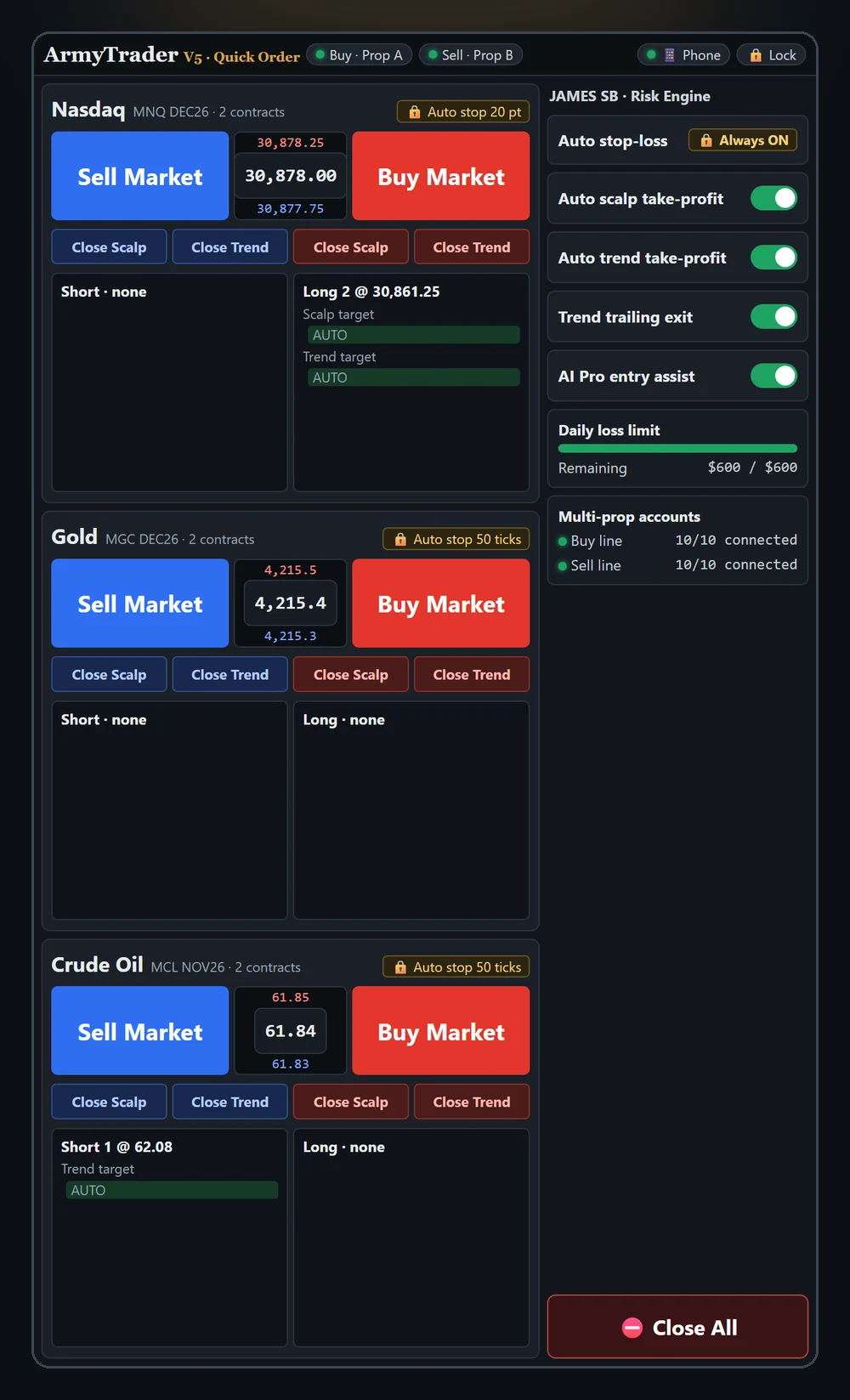
- Order panel — you click buy or sell yourself.
- Automatic stop-loss — every order is protected; the daily safety stop prevents a blown account.
- Free beta: auto take-profit, TFTS, re-entry, AI PRO and multi-account copy are locked (paid plan later, $49/month).
Stuck at any step? Tap 💬 Help at the bottom right — our AI answers instantly, and a person takes over if needed.
Not financial advice. ArmyTrader SB shows signals; you decide and place every order yourself. Past results, including real member results, do not guarantee future profits. Futures trading involves a substantial risk of loss.